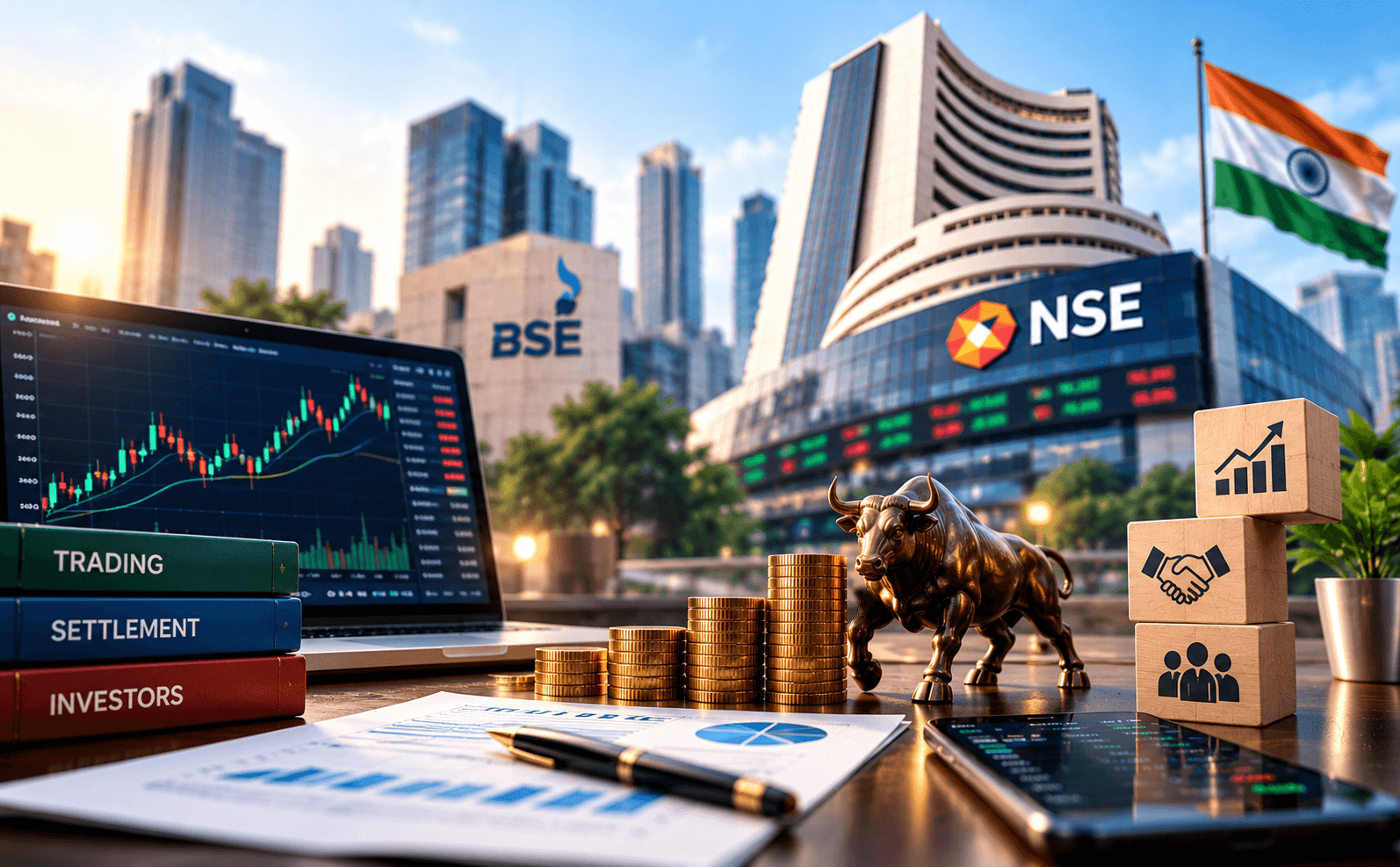
Overview of the Indian Stock Market
The Indian stock market serves as a crucial financial platform for buying and selling shares and securities, linking companies in need of capital with eager investors. It plays a pivotal role in establishing security prices through buyer-seller interactions.
Key exchanges include the Bombay Stock Exchange (BSE) and the National Stock Exchange (NSE), regulated by the Securities and Exchange Board of India (SEBI). These institutions, along with brokers and clearing corporations, facilitate trading and ensure market integrity.
Understanding the Stock Market
The stock market is an essential component of capital markets where shares of listed companies are traded. Investors gain ownership stakes through equity shares, typically acquired during Initial Public Offerings (IPOs) when companies first go public. Post-listing, shares are traded among investors, who seek returns through price appreciation and dividends, while also facing risks of potential losses.
Major Stock Exchanges
- Bombay Stock Exchange (BSE): Established in 1875, it's Asia's oldest stock exchange and is known for its widely tracked BSE Sensex index.
- National Stock Exchange (NSE): Launched in 1994, it modernized trading with automated systems and features the impactful Nifty 50 index.
Both exchanges enhance organized trading and price discovery.
Mechanics of the Indian Stock Market
Trading involves several steps:
- Account Setup: Investors need a trading account with a broker and a demat account to hold shares electronically.
- Order Placement: Investors submit buy or sell orders via brokers, indicating specifics like security and quantity.
- Order Matching: Exchanges match orders based on established rules to facilitate transactions.
- Clearing and Settlement: After trades are executed, obligations are settled, typically on a T+1 basis, where settlement occurs one business day post-trade.
- Holding Shares: Post-settlement, shares are held in the investor's demat account, enabling monitoring and decision-making.
Market Regulation
The Indian stock market is governed by a robust framework including:
- SEBI: Oversees market regulation and investor protection.
- Stock Exchanges: Provide trading platforms and monitor activity.
- Brokers and Depositories: Facilitate transactions and manage electronic records.
This structured environment aims to promote transparency and orderly trading.
Primary vs. Secondary Markets
- Primary Market: Involves new securities issuance, like IPOs.
- Secondary Market: Existing securities are traded, allowing previous investors to sell.
Factors Affecting Stock Prices
Stock prices fluctuate due to:
- Company performance
- Economic conditions
- Corporate announcements
- Industry trends
- Investor sentiment
Understanding these components is key to navigating the stock market successfully.
Stock Market Indices
Indices like the BSE Sensex and NSE Nifty 50 track the performance of select securities, offering insights into market trends.
Initial Public Offerings (IPOs)
IPOs enable companies to sell shares to the public, with the allotment process subsequently determining share distribution for trading.
Investment Risks
Investing in stocks comes with inherent risks, including:
- Market risk
- Company-specific risk
- Liquidity risk
- Volatility risk
- Information risk
Investors should exercise due diligence and assess their risk tolerance before investing.
Frequently Asked Questions (FAQs)
How does the stock market operate?
Orders are processed through brokers and matched on exchanges, with settlement facilitated by clearing institutions.
NSE vs. BSE?
Both are distinct exchanges with their own trading systems and indices.
Is a demat account necessary?
Yes, it is typically required for holding shares electronically.
What is T+1 settlement?
T+1 means settlement happens one business day post-trade.
Can profits be guaranteed?
No, the stock market carries inherent risks with no guaranteed returns.
Conclusion
The Indian stock market operates through a comprehensive system supporting trading, investor engagement, and financial transactions. Understanding market dynamics, processes, and associated risks is crucial for making informed investment choices.
Disclaimer
This article is for educational purposes and does not offer investment advice.